Showing posts with label Evolution. Show all posts

Tuesday, 19 November 2013

What will humans look like in 100,000 years?


Article Author : Mr Michael Graham Richard


The future is always unknown, especially the distant future, but that shouldn’t stop us from making educated guesses. That’s exactly what artist and researcher Nickolay Lamm did with help from Dr. Alan Kwan, who has a doctorate in computational genomics from Washington University. Their starting point was the question: “What do you think the human face might look like in 100,000 years and why?”
From there, they reasoned out how humanity with advanced genetic engineeringtechnology might reshape itself over time, taking over the role played by natural selection so far. Lamm then created a series of images of what he thinks the human face might look like 20,000 years, 60,000 years and 100,000 years in the future (Note: He said that we shouldn’t read too much into the fact that the man and woman are Caucasian because those were just the best models he could find).


The first image is an unmodified photo of a man and woman from the present. Nothing special.

Image: 20,000 years


This one shows some changes, but they are not too major yet. Heads are a bit bigger to accommodate larger brains, and those yellow rings that you see in the models’ eyes are special lenses that act kind of like Google Glass does today, but in a much more powerful way.

Image: 60,000 years


In the 60,000 years image, we’re starting to see some major changes. Heads are even larger, but the eyes have grown too. Lamm speculates that this would be a result of human colonization of the solar system, with people living farther away from the sun where there is less light. Skin pigmentation would change and our eyelids would become thicker to offer more protection against UV rays for those living outside of the Earth’s protective ozone layer.

Image: 100,000 years


100,000 years! Here Lamm predicts big changes, the most notable of which is the big Japanese Manga-style eyes that may feature “eye-shine enhance low-light vision and even a sideways blink from re-constituted plica semilunaris” to offer extra protection against cosmic rays. These futuristic faces follow the golden ratio proportions and are perfectly symmetrical from left to right, and have larger nostrils to make breathing in off-planet environments easier, as well as denser hair to contain heat loss from their even larger heads. Various implants might allow the man and woman of the future to always be connected, but these would be subtle and almost invisible.


Now remember, Nickolay Lamm and Dr. Kwan stress that this is not a prediction, but rather speculation (“one possible timeline”), and that it is impossible to know for sure what the future holds. This is just their answer to the question “What do you think the human face might look like in 100,000 years and why?” There are, without a doubt, many other answers, some of which might seem more plausible. But it’s interesting food for thought.
Personally, if I had to criticize this project, I would say that the timeline is probably too long. We’re already starting to have the ability to modify ourselves, so if we ever decide to do so (it’s probably a question of “when” rather than “if”), it probably won’t take thousands of years. Just in the past 100 years, we've gone from barely having mastered powered flight with the Wright Brothers to landing space probes on almost all planets and moons of the solar system, from Morse code telegraphs to a worldwide communication network made up of billions of electronic devices, each of which is more powerful than the supercomputers of a few decades ago. So technological and scientific progress is really fast and it’s accelerating. The human race’s capabilities in 50 years should be even more impressive to us today than today’s tech would be for someone from 50 years ago — and that’s saying something.
My own speculation on how humans might modify themselves over time would probably go into a different direction than Lamm’s — and  wouldn’t result in very striking images because I think most changes wouldn’t be visible. For example, if we successfully cure the diseases of aging (the SENS Research Foundation is working on this, for example), we would look the same, except that people would keep their young adult bodies, and you might not be able to superficially tell the difference between someone who is 30 and someone who is 60 years old. Maybe we’ll upgrade the human eye to give ourselves piercing hawk-like vision and awesome low-light capabilities, but that eye 2.0 might not look different from the outside. Same if we improve our red blood cells so they can carry 10 times more oxygen, our livers to better eliminate toxins or our metabolisms to maintain a healthy weight whatever we do. All these changes would be huge for humanity, yet they might not be visible in a photograph.
But all that is just speculation, one of many possible futures. The bottom line is we can all have an impact on how the future turns out, so let’s make it a good one.


Images courtesy of Nickolay Lamm
Article Source: Mnn.com

Monday, 11 November 2013

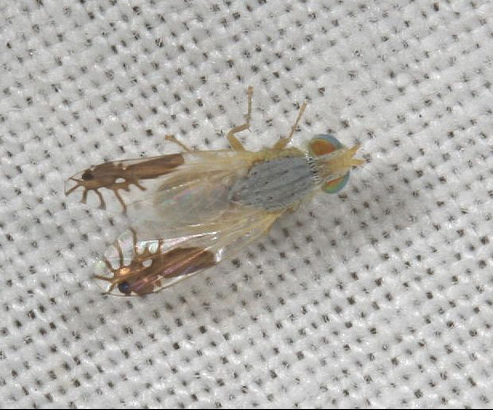
Fly with ant-mimic wings

Those aren’t ants bedecking the fly’s wings; they’re the normal wing markings of this species. But why would a fly have antlike markings on its wing?
The issue is discussed in a New York Times‘s “Dot Earth” column by Andrew Revkin, which refers back to the original article in the original article by Anna Zacharias in The National, a United Arab Emirates newspaper. Zacharias describes it:
The image on the wing is absolutely perfect,” says Dr Brigitte Howarth, the fly specialist at Zayed University who first discovered G tridens in the UAE. [JAC: the species has been known since 1910, and is found in the Near and Middle East, Asia, and Asia.]
. . .In the UAE alone, 27 picture wing species are known. Some have wings bearing simple shapes but others, like G tridens, are far more complex.
Dr Howarth first saw G tridens on an oleander shrub in northern Oman. “I was looking at the stem of the leaves and I noticed that there were some insects crawling around. When I sort of honed in I started to notice what I thought was a couple of ants moving around.”
At first she suspected an infestation on the fly’s wings. “But it was so symmetrical that I thought, ‘oh this is not possible’. When I got it under the microscope I realised that these were insects painted onto the wings.”
In contrast to its wings and brilliant green eyes, the fly’s body is a dull greenish grey – “almost cryptically coloured,” says Dr Howarth – that blends into the leaves where it is found
Here’s a photo (uncredited) of a pinned specimen from The National:


But why the ant markings? Howarth, interviewed by Zacharias, explains:
When threatened, the fly flashes its wings to give the appearance of ants walking back and forth. The predator gets confused and the fly zips off.
That doesn’t make a lot of sense to me.  Why doesn’t the fly just “zip off” by flying away when it sees a predator? Confusing a predator by waving your wings just wastes time.  Now some tephritids have spider-like markings on them, and that makes more sense.  Apparently the predator is a jumping spider, and when it sneaks up on a fly, it sees the spider markings, mistakes them for another spider of its species, and displays to it. That display gives away the spider’s presence, allowing the fly to get away.  But I can’t see this happening with ants.
Howarth also suggests a sexual function:
This defence mechanism may also make the fly attractive to potential mates – something that is less of a concern for the average housefly.
“A lot of flies, if a male sees a female that is suitable it just flies up and tries to latch on,” said Dr Howarth. But G tridens has an altogether more amorous courtship, showing off its wings in a colourful dance. And Dr Howarth believes it is no exception.
“If you look at the behaviour, it tells you a lot about the functionality,” said Dr Howarth. “Not everybody gets to mate. The ones that do have something about them that make them more attractive.
“Is it the same in other invertebrates, who knows? It’s very possible that those are in fact for courtship behaviour.”
That makes even less sense.  Yes, marks on the wings can help courtship, but why would ant-shaped markings on the wings be necessary for that? It’s not like females are attracted to ant shapes because the flies eat ants, because they don’t. No, there’s something here about the resemblance to the ants that facilitates the fly’s survival or reproduction.  Howarth’s final statement doesn’t make a lot of sense to me, either:
This elaborate behaviour may be a response to the fly’s restrictive environment. “Something that can survive anywhere doesn’t need to have as many protection factors,” said Dr Howarth.
The more realistic the picture on the wing, the better its chance of survival and reproduction.
The truth is that we don’t really know why this fly has antlike markings, but we can predict that studying how the fly uses its wings, and knowing more about its ecology, will suggest some testable hypotheses. I’m too harried to think about alternatives now, but I bet some readers, particularly our entomologists and field biologists, can suggest an evolutionary explanation for ant markings.
Finally, here’s a flickr picture by Drew Gardner (I cropped it a bit), who notes, “Another pictured wing fly. This is a small fly about 3 mm long which came to the mercury vapour light. Each wing has an almost perfect picture of an insect, complete with head, thorax and abdomen and six legs.”


Tuesday, 22 October 2013

The Evolution Of Reality by Terence Mckenna

Transcedence + Ascension = TRANSCENSIONThe transcension hypothesis asks whether our civilization is rapidly developing into something analogous to a black hole Some physicists also argue black holes may be "seeds" or "replicators" for new universes, thus giving us a clue as to what we would do after we meet up with other intelligence


Check out this Page on Facebook > Do More Thinking


Tuesday, 24 September 2013

We Are Already Cyborgs

"If human history is the story of a creature who molts from ape toangel - or, as Nietzsche claimed, from beast to Superman - then somewhere along the way it seems that we must become machines" -Erik Davis


Thursday, 5 September 2013

The Evolution of Consciousness

“You must unlearn what you have been ‘programmed’ to believe from birth. That software no longer serves you if you want to live in a universe where all things are possible.” -Jacqueline E. Purcell The world is in crisis and transformation. Now, our civilization has the opportunity to evolve its thinking. We are beginning to realize that the old ways of competition and 'survival of the fittest' are not sustainable for individuals, businesses, or the planet. Nature may be our most qualified life coach, with millions of years of experience in creating sustainability. It's time to look to Her wisdom for some answers. It's time to do something different; the evolution occurs when we try smarter - not harder!


“The crisis is a crisis in consciousness, a crisis that cannot anymore accept the old norms, the old patterns, the ancient traditions and considering what the world is now, with all the misery, conflict, destructive brutality, aggression and so on. Man is still as he was, is still brutal, violent, aggressive, acquisitive, competitive and... he has built a society along these lines.” -Jiddu Krishnamurti “We don't have to engage in grand, heroic actions to participate in the process of change. Small acts, when multiplied by millions of people, can transform the world.” -Howard Zinn 


“The awakening of consciousness is the next evolutionary step for mankind.” -Eckhart Tolle 

We hope you enjoyed this article and video on the Evolution of Consciousness.

Please join us on Facebook by clicking on the image below.


Source for this article: Social Consciousness

Wednesday, 26 June 2013

An important message - The Pale Blue Dot by Carl Sagan

An important message every person on earth should hear - The Pale Blue Dot


Carl Sagan delivering an important message every person on earth should hear.. Please share this message in anyway possible.

The Pale Blue Dot is a photograph of planet Earth taken in 1990 by the Voyager 1 spacecraft from a record distance of about 6 billion kilometers (3.7 billion miles) from Earth, in the photograph, Earth is shown as a tiny dot (0.12 pixel in size) against the vastness of space. 


Want to see more Blogs like this?   
 Click here > EducateInspireChange

Want to go to our Facebook Page? 
 Click here > EducateInspireChange